
· Manfredi Miraula · Case Study · 2 min read
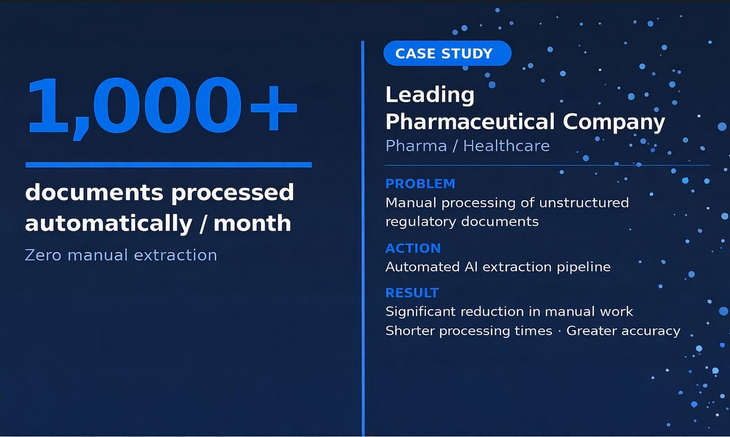
1,000+ documents processed automatically every month. Zero manual extraction.
A major pharmaceutical company was spending hours every week manually processing unstructured regulatory documents. We built an automated extraction pipeline. Result: significant reduction in manual work, shorter processing times, greater accuracy.
Every week, the same ritual. Open a PDF, read the content, copy the data into a spreadsheet. Then the next one. And the next.
For a major pharmaceutical company, this process consumed hours of the team’s time every week — and repeated itself for hundreds of documents per month.
The problem
The company manages a continuous flow of regulatory documents: clinical reports, compliance dossiers, inspection reports, scanned paper forms. None of these have a standard format. Structure, layout and terminology change from document to document, from country to country.
The result: no existing automated system could handle them. The team had to do it manually.
The solution
We designed and implemented an end-to-end automated extraction pipeline:
- Multi-format ingestion — native PDFs, OCR scans, Word documents, emails with attachments: the system handles any input
- Intelligent classification — a model recognises the document type and applies the correct extraction logic
- Data structuring — relevant fields are extracted, validated and written to the target system (ERP, database, data warehouse)
- Human escalation — ambiguous cases are flagged for manual review with context already pre-filled
No rigid templates. The system adapts to the variability of real-world documents.
The results
- 1,000+ documents/month processed automatically without human intervention
- Zero manual extraction for standard cases
- Significant reduction in processing times end-to-end
- Greater accuracy compared to manual entry, with a full audit trail
The principle that applies everywhere
The same logic applies to any sector that works with unstructured documents: law firms, notarial offices, compliance departments, banks, insurance companies.
If your team is copying data from PDFs into spreadsheets, there is a better way.
It doesn’t require a radical transformation: you need to identify the right workflow and build something precise around it.
Have a similar problem? Contact us — let’s figure out together if we can help.